


Picture a Friday afternoon: A critical raw material shipment is delayed at a Tier-2 supplier’s facility in Southeast Asia. Your current ERP flags the delay, but the action stops there.
Your Head of Planning spends the next four hours manually emailing logistics partners, checking safety stock levels, and trying to model the impact on next week’s production schedule. By the time a decision is reached, the premium air-freight window has closed, and the cost of the delay has tripled.
This is the "Execution Gap." It is the silent P&L leak where data exists, but the ability to act on it is throttled by manual human workflows. As we enter 2026, the solution isn't just better software. It is a fundamental shift toward Agentic AI and the leaders who can orchestrate it.
1. The Rise of the "Agentic AI" Orchestrator
The most significant shift in the 2026 landscape is the emergence of Agentic AI. While 2025 was defined by the experimentation of Generative AI (tools that advise), 2026 is about autonomous agents (tools that act). These systems execute procurement cycles and logistics routing with minimal supervision.
However, a critical gap has emerged. Many organizations are investing in the tools but failing to hire the people capable of managing them. According to the ASCM Top 10 Trends for 2026, the value of a Chief Procurement Officer (CPO) is no longer found in the software they procure, but in their ability to upskill a team to work alongside these autonomous agents. We are no longer looking for "operators"; we are headhunting for Orchestrators.
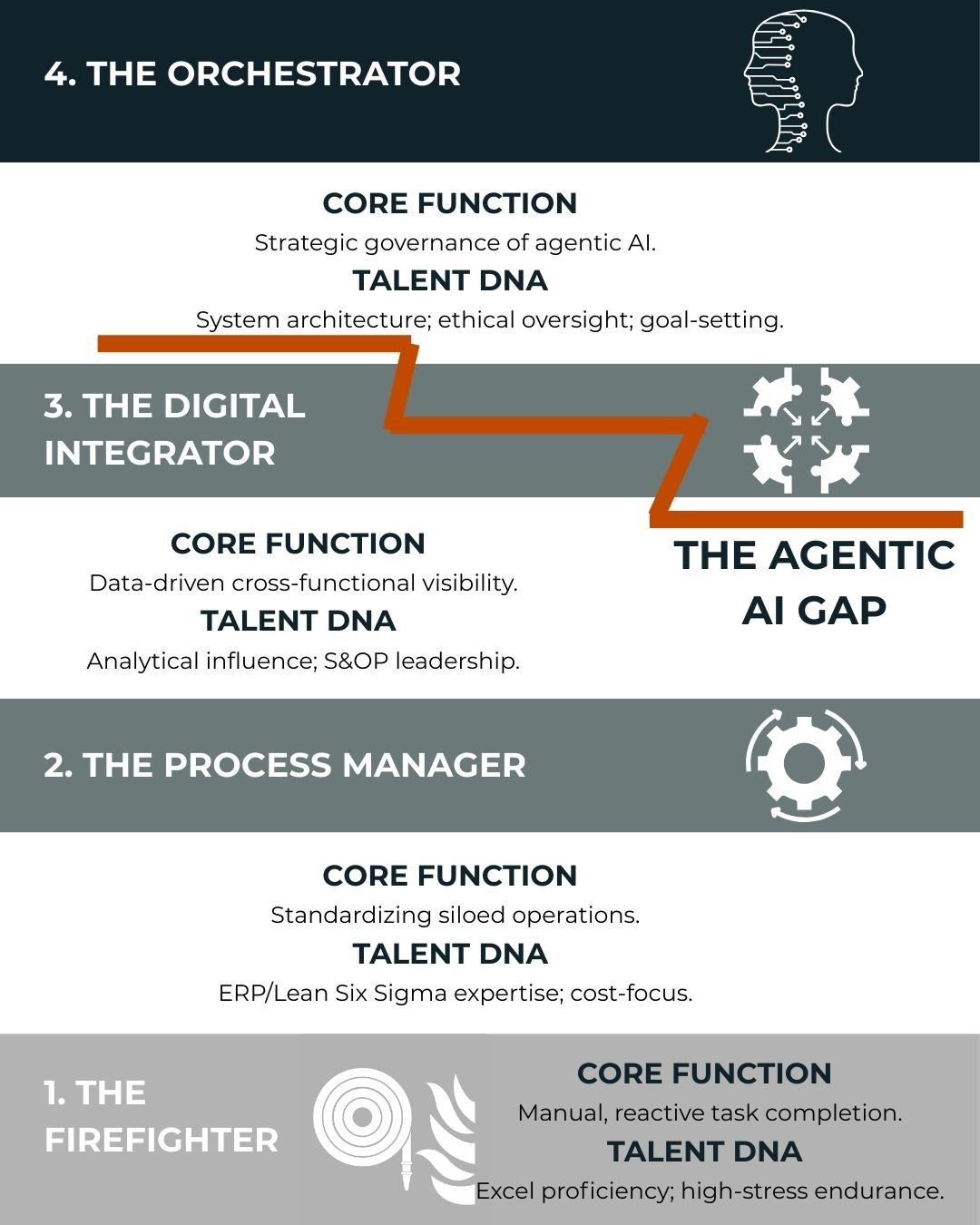
The Four Stages of the Talent Maturity Model
2. The Logic-First Interview: Finding the Orchestrator
While behavioral interviewing has its place, it often fails to reveal how a candidate will co-pilot with autonomous systems. To identify an Orchestrator, we must move the conversation away from historical anecdotes and toward Future-State Logic.
The "Agentic" Stress Test
Instead of asking for a past story, present a live conflict between human ethics and AI efficiency.
The Scenario:
"We have deployed an AI agent to manage tactical sourcing. It identifies a 15% cost-saving opportunity by switching to a new supplier, but that supplier’s Sustainability Index is 5 points below our corporate threshold. How do you design the “Guardrail” that allows the agent to negotiate the deal without compromising our ESG commitment?"
What to look for:
You are looking for a Level-4 leader. A legacy candidate will simply say they would "override the system" or do it themselves. An Orchestrator will describe how to build a governance framework, setting the dynamic parameters that allow the machine to learn exactly where the company's ethical line is drawn.
3. Benchmarking Talent Velocity
In 2026, the metric that defines a successful search is Talent Velocity. This goes beyond "Time to Fill"; it measures the delta in team output once a new leader begins managing their "Agentic" workflows.
As highlighted by recent search trends, high-performers are no longer moved by salary alone. They are seeking Operational Autonomy. To close elite talent, the final offer must be presented as a Partnership Agreement rather than a financial transaction. If you treat a candidate like a tactical line item during the offer stage, do not expect them to act like a strategic architect once they are on the payroll.
The Lean Six Search Perspective
Hiring is the most important supply chain you manage. If your input (talent) is mediocre, your output (execution) will be as well. At Lean Six Search, we specialize in identifying the orchestrators who can bridge the gap between legacy operations and the autonomous future.
Strategic Intelligence & Sources
This edition of Link by Link was developed using insights from the following global research:
ASCM (Association for Supply Chain Management): Top 10 Supply Chain Trends for 2026.
Gartner: The Future of Supply Chain Talent & Human-Centric AI.
MIT Center for Transportation & Logistics: Digital Transformation and the Skills Gap Analysis.
Lean Six Search Data: Q1 2026 Executive Search Velocity Trends.
Tell us what you think